Dates: Saturdays from 25 July to 3 October 2026 (10 sessions*, see below for exact dates)
Time: 2.30pm – 4.30pm
Venue: The Buddhist Library
Registration: Click here
About this Program
“In the book “Who Is My Self” by Ayya Khema, three conditions were listed for the practice of meditation to bear fruit: Firstly, to know our own dukkha, to recognise where it comes from, and how it operates in our lives; the second is to gain confidence in the Buddha’s teaching and to realize that we can take this path; and the third is to experience joy at the opportunity we have been given.”
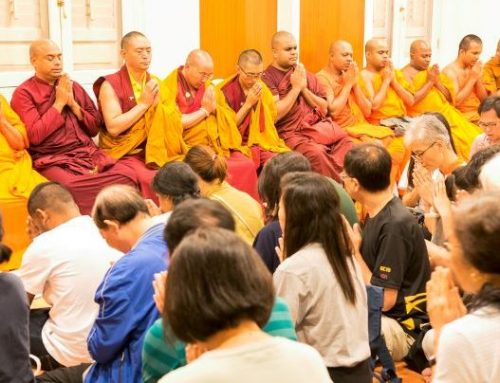
The Meditation and Dhamma class is a recurring programme at the Buddhist Library and is one of its more popular programmes. This July’s run of the class comprises 10 sessions, and during each lesson the Class Mentors will lead meditation sessions as well as run through specific teachings of the Buddha. Time is also allocated for Q&A.
In this run, for the first 3 sessions, a separate meditation class will be held for participants who have not meditated before.
Who is this Program For?
- Those who have been attending previous runs of the class
- Persons looking to strengthen their understanding of Buddhism and their practice
- New practitioners who have no knowledge of Buddhism or meditation, but have a keenness to learn
What are the Topics?
These are the 3 Dhamma Bites topics we are covering from July to October 2026:
The Pāli Canon – 2 sessions
- How were the Buddha’s teachings preserved and handed down to us?
- How accurate are the recorded teachings in the Pāli Canon?
- Is Pāli a language? Why are the Buddha’s teachings recorded in Pāli and not Sanskrit?
- How is the Pāli Canon organized?
Chachakka Sutta (MN 148) – 4 sessions
- Our communication with the outside world occurs through our six sense bases which give us sight, sound, smell, taste, touch and thought. It is through these six sense bases that we get the entire length, breadth and depth of experience in our saṃsāric existence.
- Of the vast assortment of texts dealing with the six sense bases, the Chachakka Sutta (MN 148), popularly known as the Six Sets of Six, is perhaps the most comprehensive one in the Pāli Canon. Not only does it encompass all the principal tenets of the Buddha’s teaching, this discourse also forms the important link between theory and practice as it is primarily a spiritual training that employs contemplation of the factors of sense experience to release ego identification.
- This sutta is often under-appreciated because the contents can appear dry, boring and unnecessarily repetitive, especially to those who are new to the BuddhaDhamma. In our Dhamma Bites from 8 to 29 August, we aim to provide a broader and deeper understanding of this sutta and explain how it ties in with the core teachings of the Buddha and helps in the realization of not-self.
Vitakkasaṇṭhāna Sutta (MN 20) – 4 sessions
- The Vitakkasaṇṭhāna Sutta teaches five practical methods as part of a graduated strategy – from gentle redirection to firm restraint – for dealing with unwholesome or distracting thoughts. The Buddha teaches that these five methods are to be used “from time to time” as a skilful means to quiet the mind whenever it goes off track from the main meditation object. This sutta is therefore one of the most useful suttas for addressing frequently-asked questions from meditators who struggle with intrusive thinking, restlessness and mental proliferation:
-
- What do I do when the same distracting thoughts keep coming back when I meditate?
- When I switch to another method to quiet down my mind, isn’t that also a distraction from my main meditation object?
- How do I stop these distracting thoughts without suppressing them?
- How do I know which method to use to deal with my distracting thoughts?
- How do I handle thoughts that are emotionally heavy like anger, fear or sexual desire?
About the Class Mentors
The Meditation and Dhamma class mentors are Sis Foo Siew Ee (bio here), Sis Tan Sock Hoon, Bro Tan Chau Yee (bio here) and Sis Foo Siew Fong (bio here).
The Meditation and Dhamma class mentors aim to help fulfil the conditions described by Ayya Khema (as mentioned at the onset of this webpage). And they do it by sharing the strength and beauty of the Buddha’s teachings in a simple, clear and digestible way, practising various meditation techniques as taught by the Buddha, and providing practical applications for everyday life.
Through these weekly sessions, they hope to inspire in all participants an abiding curiosity, interest, and determination to explore the Dhamma and live life according to the Buddha’s teachings.
Dates and Indication of Attendance
10 Saturdays*
- Jul 25
- Aug 1, 8, 15, 22, 29
- Sep 12, 19, 26
- Oct 3
*No class on 5 September 2026.
Registration: please indicate your attendance here.
Donations
This programme is freely offered. To recoup the costs involved in running the Library and its programmes, do consider making a donation. The most expedient way to make a donation is by PayNow to UEN S81SS0026HBRS or scan below; do include the text “donation” in the Reference field. For other ways to donate, please see here.